Mining vehicles operate where flying rock, steel fragments, vibration, dust, and sudden temperature changes can meet the windshield within seconds. This makes glass selection a safety decision, not a simple purchasing choice. The key question is: What is the impact rating needed for mining vehicle glass? The answer depends on vehicle speed, operating conditions, debris size, cab design, and the consequences of glass failure.
The U.S. Mine Safety and Health Administration recorded 31 mining fatalities in 2023, reminding manufacturers that equipment protection requires evidence, not assumptions. NIOSH research also identifies mobile equipment interaction and line-of-fire exposure as continuing mining hazards. For Chinese mining vehicle suppliers, standards such as ANSI/SAE Z26.1, ISO 16321, ECE R43, and relevant OEM specifications can provide useful testing frameworks. However, these standards do not create one universal “mining glass rating.” A laminated windshield may resist penetration, while polycarbonate can offer stronger impact tolerance but may scratch or age differently.
Safety pioneer H.W. Heinrich wrote, “Accident prevention is not a matter of luck; it is a matter of knowledge.” That principle still matters beside a 100-ton haul truck. The correct assessment should include impact testing, optical quality, edge retention, mounting strength, and field maintenance. A higher rating is not automatically safer. Poor installation can defeat excellent glass. This guide compares China’s top mining vehicle glass options, their test evidence, and their practical limitations. Some product claims remain unclear. That deserves careful review.
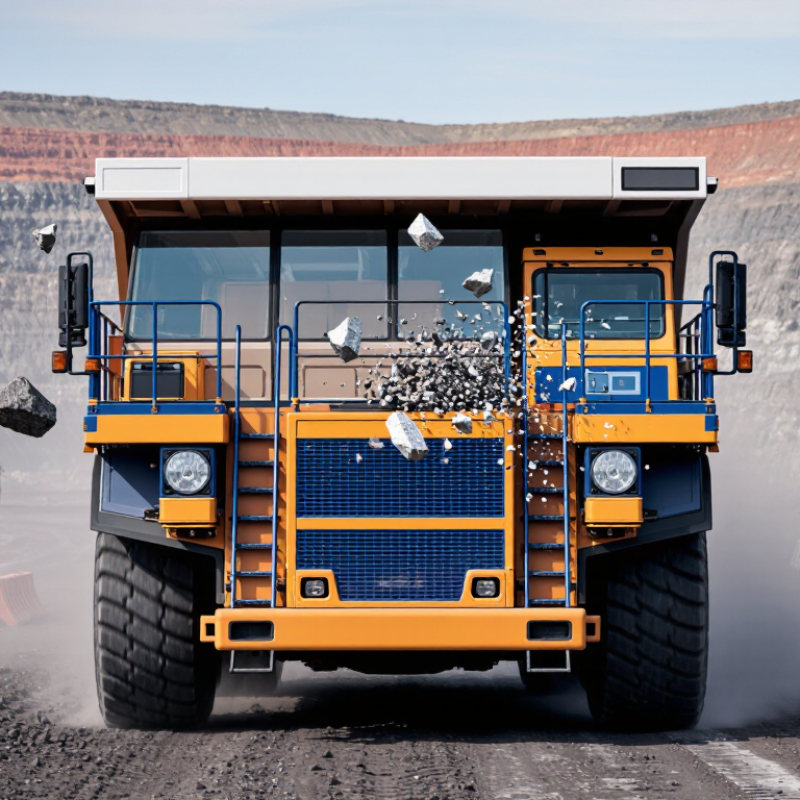
Mining vehicle glass impact ratings measure how well a glazing system resists a defined impact under controlled test conditions. The test may use specified projectiles, impact speeds, and strike locations. It checks whether the glass breaks, penetrates, or releases dangerous fragments. It is not a simple toughness score. Ratings vary between testing systems, so identical numbers may not mean identical protection.
In real mining areas, flying rock is only one concern. Glass performance also depends on thickness, interlayers, frame support, seals, visibility, and installation quality. A certified impact rating reflects its test scope, not every site hazard. That limitation matters. Dust, vibration, temperature changes, and repeated impacts can reduce practical performance. Field inspections often find damage around edges before the center becomes visibly weak. This detail is easy to overlook.
China Top 10 Mining Vehicle Glass Impact Rating Guide
Chinese standards provide the technical foundation for testing mining vehicle glass. For road-going vehicles, GB 9656 and the GB/T 5137 series commonly guide safety glazing evaluation. Their tests may examine impact resistance, fragmentation, optical quality, light transmission, and durability. However, mining vehicles often work outside normal road conditions. Their glass may face flying stones, metal dust, vibration, sudden temperature changes, and repeated cleaning. Therefore, engineers should confirm the correct standard according to vehicle classification and operating environment.
Impact testing should use controlled conditions and traceable equipment. A steel ball or other specified impact tool strikes marked areas of the glass. Technicians then record cracks, penetration, fragments, and visibility loss. Laminated windshields need special attention because the interlayer should hold broken pieces together. Tempered side glass requires controlled fragmentation. Small details matter. A dusty test surface can affect results. A poorly positioned sensor can also create uncertainty.
Experienced laboratories should keep sample identity, production batch, temperature, and test speed in the report. They should also compare new glass with aged samples after vibration, abrasion, or thermal cycling. A single pass does not prove complete field reliability. Real mine conditions can be less predictable than laboratory conditions. This is where testing plans need honest review. The most dependable rating combines Chinese standard methods, vehicle-specific risks, and documented engineering judgment.
| No. | Impact or Safety Dimension | Applicable Chinese Standard | Test Method or Load | Typical Acceptance Requirement | Mining Vehicle Application |
|---|---|---|---|---|---|
| 1 | Product classification | GB 9656, Safety Glazing Materials for Road Vehicles | Confirm the glazing type, installation position, safety-glass category, and applicable performance tests. | The glass must meet the requirements applicable to its vehicle position, such as windscreen, side window, rear window, or other glazing. | Use this as the first screening step for windscreens, doors, operator-cab windows, and replacement glazing. |
| 2 | Small-ball impact resistance | GB/T 5137.1, Test Methods of Safety Glazing Materials Used on Road Vehicles—Part 1: Mechanical Properties | A specified steel ball is released from the height and in the configuration required for the relevant glazing category. | The specimen must not create unacceptable penetration, dangerous detachment, or hazardous breakage under the applicable test condition. | Relevant to gravel, fragmented rock, and small flying particles generated during loading, hauling, or crushing operations. |
| 3 | Large-ball impact resistance | GB/T 5137.1 and the corresponding requirements of GB 9656 | A heavier steel-ball impact test is applied where required by the glazing type and installation position. | The glass must retain the required protective behavior and must not produce unacceptable openings or hazardous fragments. | Provides a useful check for larger stones and hard debris that may strike a cab window at low or moderate vehicle speed. |
| 4 | Headform impact behavior | GB/T 5137.1 and GB 9656, when applicable to the glazing category | A standardized impactor is used to evaluate the glass and its breakage behavior under a specified impact condition. | The glazing must satisfy the applicable penetration, fracture, and occupant-protection requirements for its position. | Important for operator-cab windscreens where impact protection and controlled fracture are safety priorities. |
| 5 | Tempered-glass fragmentation | GB/T 5137.1 and GB 9656 | The glass is broken at a prescribed location, and the resulting fragments are examined in the required evaluation area. | Fragment size, distribution, and absence of large dangerous pieces must comply with the applicable standard requirements. | Helps reduce the risk of large sharp shards when a tempered side or rear window is broken by rock impact. |
| 6 | Laminated-glass retention | GB/T 5137.1 and GB 9656 | Impact and breakage behavior are evaluated to verify that the interlayer retains the broken glass as required. | The interlayer must maintain the required adhesion and help prevent dangerous glass separation after impact. | Generally preferred for front windscreens exposed to repeated stone strikes and high-energy debris. |
| 7 | Edge-strength and mounting sensitivity | GB/T 5137.1; installation requirements should also be checked against GB 9656 | Mechanical performance is assessed on prepared specimens, with attention to edge condition, support, and installation geometry. | Chips, cracks, incorrect support, or excessive frame stress must not compromise the required safety performance. | Critical for rigid mining-vehicle frames, where vibration, chassis twist, and uneven terrain can transfer stress into the glass. |
| 8 | Optical quality after impact testing | GB/T 5137.2, Test Methods of Safety Glazing Materials Used on Road Vehicles—Part 2: Optical Properties | Evaluate visible-light transmittance, optical distortion, secondary image, and color recognition as applicable. | The glazing must remain within the applicable optical limits and must not create unacceptable visual distortion for the driver. | Important after repeated impacts, polishing, replacement, or surface damage that may impair operator visibility. |
| 9 | Light transmission and driver visibility | GB 7258, Safety Specifications for Motor Vehicles Operating on Roads; GB 9656 | Measure visible-light transmittance and verify the glazing position and vehicle-use requirements. | For road-registered motor vehicles, the front windscreen and front side windows generally require visible-light transmittance of at least 70%, subject to the exact regulatory application. | Use this check when a mining vehicle travels on public roads or is subject to road-vehicle registration requirements. |
| 10 | Environmental durability after impact exposure | GB/T 5137.3, Test Methods of Safety Glazing Materials Used on Road Vehicles—Part 3: Radiation, High Temperature, Humidity and Simulated Weathering | Apply the relevant weathering, humidity, temperature, and radiation-conditioning procedures before performance evaluation. | The glass and interlayer must not show unacceptable delamination, bubbling, discoloration, or loss of required safety performance. | Relevant to open-pit mines, desert sites, high-humidity locations, and vehicles exposed to strong sunlight and large temperature changes. |
Interpretation note: Chinese vehicle-glass regulations generally use compliance-based test requirements rather than a single universal “impact star rating.” The final test program should be selected according to the vehicle type, glass construction, installation position, road-registration status, and the current edition of the applicable standard.
Mining vehicle glass faces flying rock, metal fragments, vibration, dust, and sudden temperature changes. Its impact rating depends on more than thickness. Glass type, interlayer strength, curvature, edge quality, and frame support all influence performance. Laminated glass usually retains fragments after cracking, protecting the operator’s sightline. Tempered glass can offer high impact resistance, but it may shatter into small pieces.
Impact energy rises with the square of speed. A stone striking at 20 metres per second carries four times the energy of one moving at 10 metres per second. This matters near crushers, haul roads, and loading zones.
UNECE Regulation No. 43 and ANSI/SAE Z26.1 define glazing tests for impact, fragmentation, and visibility. However, laboratory results do not fully represent a dirty mine cab. Tests are not reality.
MSHA’s 2023 fatal accident data continues to identify powered haulage as a major mining hazard. That finding supports stronger attention to windscreen retention, visibility, and replacement control. NIOSH field research also highlights how dust, glare, vibration, and restricted visibility increase equipment interaction risks.
Inspectors should check chips, edge cracks, loose seals, and cloudy interlayers before each shift. Edges matter. A small frame gap can worsen glass movement during impact. Temperature cycling may also weaken seals, although the effect varies with installation quality.
I would not treat one impact score as a complete safety answer; mounting design and maintenance deserve equal scrutiny.
Comparing China’s top ten mining vehicle glass options starts with a clear impact rating framework. Do not rank them by thickness alone. Impact resistance is a system result. Review glass structure, interlayer type, edge treatment, and mounting design. Laminated glass can hold fragments together after rock impact. Polycarbonate layers may reduce weight, but they can scratch more easily. Check whether the stated rating covers flying stones, steel fragments, or repeated impacts.
Ask each supplier for independent test reports and traceable production records. The report should identify test standards, impact energy, sample size, temperature, and failure criteria. A simple “high impact” claim proves very little. Compare optical distortion near the driver’s sightline, especially around curved edges. Small visual waves can become tiring during long shifts. They may also hide uneven ground.
Field performance matters too. Inspect seal compression, frame fit, defogging performance, and replacement time. Dust often enters through weak seals, not the glass center. A good option should remain clear after washing, vibration, and temperature changes. Speak with maintenance teams who have used the glass through a full work season. Their notes may reveal cracks, scratches, or loose fittings that laboratory tests miss.
A neat comparison table can still mislead. I would leave room for uncertainty. Test one sample on the actual vehicle before approving a larger order.
Choosing the right impact rating starts with the site, not the supplier’s label. A haul truck crossing a crushed-rock road faces repeated low-energy chips, while a loader near a blasted face may encounter larger, faster fragments. MSHA recorded 40 mining fatalities in the United States during 2023, and powered haulage remains a recurring safety concern. Glass selection cannot remove every risk, but it can reduce cabin penetration and visibility loss.
Request the complete test method, impact energy, projectile shape, temperature range, and post-impact visibility result. ISO 3537 and UNECE Regulation No. 43 offer recognized safety-glazing test frameworks.
For China-based operations, GB 9656 may provide a useful baseline where its scope applies. Off-road mining equipment may need additional site or machine requirements. A high rating without test details is weak evidence.
Laminated glass helps retain fragments after cracking. Polycarbonate usually tolerates stronger impacts, but scratching, chemical exposure, and ultraviolet aging need inspection. That trade-off is easy to underestimate.
Use a lower rating only in shielded, low-debris areas with documented hazard reviews. Use a higher rating near benches, crushers, and active loading zones.
ICMM safety reporting repeatedly highlights mobile equipment risks, yet real site conditions vary sharply. A rating chosen from a catalog alone may be wrong. Review windshield damage records, fragment size, travel speed, cleaning methods, and replacement frequency before approval.
They measure resistance to a defined impact under controlled conditions. Tests examine cracking, penetration, fragments, and visibility loss.
No. A rating covers specific test conditions, not every mine hazard. Dust, vibration, heat changes, and repeated impacts can weaken performance.
Check the projectile, impact speed, strike location, sample size, temperature, and failure result. The report should identify the production batch.
Strong glass can perform poorly in a weak frame. Incorrect mounting, damaged seals, or poor alignment may increase edge cracks.
Look for chips, edge cracks, cloudy areas, and loose seals. Damage near the frame deserves careful attention.
Laminated glass can hold broken pieces together. Polycarbonate may resist stronger impacts, but scratches, chemicals, and ultraviolet aging remain concerns.
Match the rating to site debris, vehicle speed, loading activity, and travel routes. Crushers and blasted faces usually require stronger protection.
No. Compare new and aged samples after vibration, abrasion, and temperature cycling. Real conditions are messier.
Replace it promptly after penetration, spreading cracks, serious chips, or poor visibility. Minor damage can be harder to judge than expected.
Trusting an impressive number without test conditions. I would question unclear evidence and review the decision again.
This guide explains how mining vehicle glass impact ratings measure resistance to flying stones, tool strikes, vibration, and other hazards found in demanding mining environments. It introduces the Chinese standards and testing principles used to evaluate safety glass, including impact energy, penetration resistance, fracture behavior, and test consistency. The guide also examines the key factors affecting performance, such as glass thickness, layered construction, interlayer strength, edge quality, installation method, and exposure to temperature changes.
It then provides a practical framework for comparing China’s top 10 mining vehicle glass options by reviewing their impact ratings, optical clarity, durability, maintenance needs, and suitability for different operating conditions. The central question is: What is the impact rating needed for mining vehicle glass? The answer depends on vehicle type, site hazards, operating speed, weather, and regulatory requirements. Selecting the correct rating helps balance protection, visibility, service life, and overall operating efficiency.

Aero Glass